If you drive in Brampton, you know how brutal the summer sun can get. Your car turns into a greenhouse, the steering wheel burns your hands, and the A/C struggles to keep up. That is why so many drivers finally book window tinting Brampton every spring.
But the first question is always the same: How much does it cost?
The answer depends on two things: the film quality you choose and the type of vehicle you drive. A small sedan costs less than a minivan with eight windows. A premium ceramic tint costs more than a basic dyed film—but delivers far better heat rejection and lasts significantly longer.
This 2026 guide gives you a clear understanding of pricing based on real data from Autotailors . No hidden fees. No marketing tricks. Just honest information for car window tinting Brampton services.
Window Tint Cost in Brampton (2026)
Prices depend on two things: the film quality and your car type. Here is the complete price breakdown for auto window tinting Brampton at Autotailors in 2026.
| Vehicle Type | Dyed Film | Carbon Film | Ceramic Film |
| 2-door Coupe | Starting from $XXX | Starting from $XXX | Starting from $XXX |
| 4-door Sedan | Starting from $XXX | Starting from $XXX | Starting from $XXX |
| SUV / Crossover | Contact for Quote | Contact for Quote | Contact for Quote |
| Truck (all windows) | Contact for Quote | Contact for Quote | Contact for Quote |
| Hatchback | Starting from $XXX | Starting from $XXX | Starting from $XXX |
For accurate pricing, please contact Autotailors for a custom quote. Prices vary based on vehicle size, window count, and film selection.
What These Numbers Mean for You
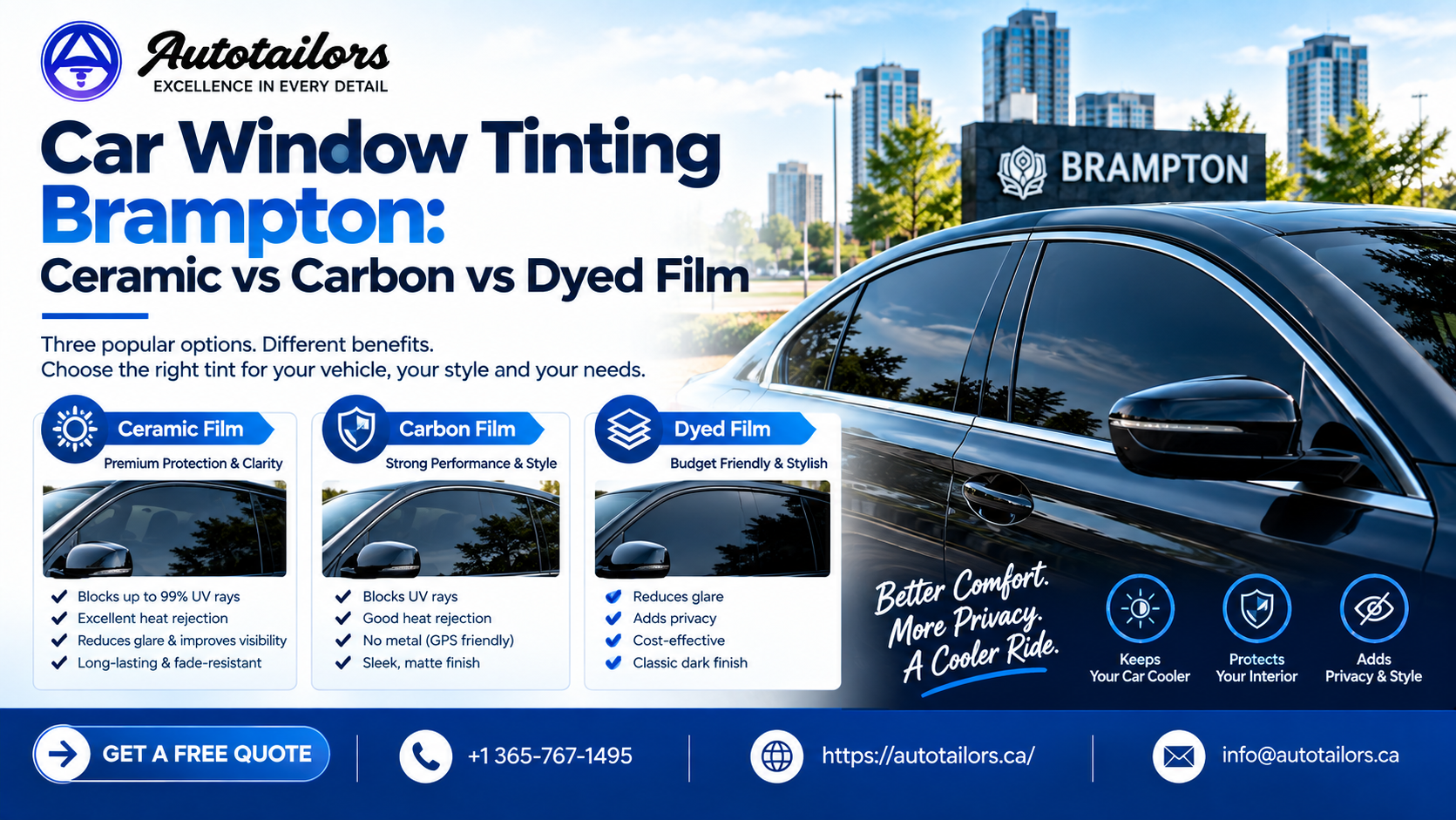
- Dyed Film: The most affordable option. Blocks glare but offers limited heat rejection. Fades faster than other films—typically lasts 2–3 years.
- Carbon Film: Mid-range option with a matte finish. Blocks about 40% of infrared heat. Does not fade like dyed film and lasts 7–10 years.
- Ceramic Film: The premium choice. No metal content, so it does not interfere with GPS, radio, or phone signals. Blocks up to 90% of infrared heat and lasts 10–15 years.
According to Bumper.com , window tinting ranges from a basic dye-film job that fades within two years to a premium ceramic installation that outperforms factory glass on heat rejection for a decade. Cheap dyed film rejects 20–40% of solar heat, while quality ceramic film rejects 50–80%. On a hot day, the difference between good and poor tint is significant in cabin temperature.
According to Wikipedia , window film is a thin laminate film that can be installed on glass surfaces in automobiles, boats, and buildings. It is usually made from polyethylene terephthalate (PET) and is available in many different compositions with varying effects on optical and mechanical properties. Window films filter out over 99% of UV rays, reducing the main factor in fading.
Cost vs. Value: Which Film Gives the Best Return?
| Film Type | Initial Cost | Lifespan | Heat Rejection | UV Protection | Long-Term Value |
| Dyed Film | Low | 2–3 years | 20–35% | Moderate | Moderate |
| Carbon Film | Medium | 7–10 years | ~40% | High | Good |
| Ceramic Film | High | 10–15+ years | 80–90% | 99% | Excellent |
Why Long-Term Value Matters
Dyed film may save you money upfront, but you will likely need to replace it in 2–3 years. That means paying for removal, new film, and installation again.
Ceramic film costs more initially but lasts 10–15 years with a lifetime warranty. Over a decade, ceramic tint often ends up being more cost-effective than replacing dyed film multiple times.
Brampton drivers who plan to keep their vehicles for 5+ years should strongly consider ceramic tint. The heat rejection alone makes summer driving more comfortable and reduces A/C strain, which can improve fuel efficiency.
According to Ceramic Pro , ceramic tint blocks up to 80–90% of infrared heat, significantly more than carbon or dyed films. This means your vehicle stays cooler, and your A/C does not have to work as hard—improving fuel efficiency in gas-powered vehicles and range in EVs. Ceramic films typically block 99% of harmful UV rays and have zero impact on cell phones, GPS, satellite radio, or Bluetooth.
Why Prices Vary in Brampton
Not all tint shops charge the same. Some use cheap film that turns purple after one winter. Others, like Autotailors, use premium rolls from trusted brands like 3M and Suntek.
Here is what changes the final bill for window tinting Brampton .
1. Film Material
The type of film you choose has the strongest influence on pricing:
- Dyed film: The most affordable option. Uses a layer of dye to darken windows. Blocks glare but little heat. Can fade or turn purple over time.
- Carbon film: Mid-range option. Contains carbon particles that block infrared heat without fading. Matte finish. Does not interfere with electronics.
- Ceramic film: The premium option. Uses nano-ceramic particles to block heat and UV rays. No metal, no signal interference. Superior clarity and durability.
2. Number of Windows
A two-door car has four side windows plus a rear glass. An SUV has seven or eight windows plus the rear hatch. More glass means more film and more labour.
According to industry data, sedans generally cost less for complete window tinting, while SUVs and larger vehicles cost more due to increased glass surface area and labour time.
3. Old Tint Removal
If your car already has old, bubbling tint, removal costs extra. Add to the total for stripping and glue cleaning.
4. Vehicle Complexity
Luxury vehicles and cars with complex window shapes can increase installation difficulty, which adds to overall cost compared to standard sedans or compact vehicles.
According to Consumer Reports , window tinting can protect your car’s interior from UV damage and reduce heat, but the quality of installation and film type significantly affects performance and longevity. Their buying guide emphasizes choosing reputable installers and understanding the differences between film types.
Ceramic vs. Carbon vs. Dyed: Which Should You Choose?
| Feature | Dyed Film | Carbon Film | Ceramic Film |
| Heat Rejection | Low (20–35%) | Moderate (40%) | High (80–90%) |
| UV Protection | Moderate | High | 99% |
| Signal Interference | None | None | None |
| Clarity | Moderate | Good | Excellent |
| Durability | 2–3 years | 7–10 years | 10–15+ years |
Choose Ceramic Tint If:
- You drive a modern vehicle with GPS, Bluetooth, or satellite radio
- You want maximum heat rejection for Brampton summers
- You plan to keep your car for 5+ years
- You want to protect your interior from UV damage
- You value long-term durability
Choose Carbon Tint If:
- You want better heat rejection than dyed film
- You are on a moderate budget
- You want a film that will not fade over time
- You do not need maximum heat rejection
Choose Dyed Tint If:
- You are on a tight budget
- You primarily want basic shading and privacy
- You plan to sell your car in 2-3 years
- You do not drive much in extreme heat
Ontario Tint Laws: What You Need to Know
Before you book your appointment, you must know Ontario’s tint laws. Break them, and you will pay fines. Worse, you might have to rip off brand new film.
Ontario’s window tint rules come from the Highway Traffic Act (HTA) , specifically Section 73(2) and Section 73(3) . The law focuses on VLT (Visible Light Transmission) —the percentage of visible light that passes through your window and tint film combined.
Legal Limits in Ontario
| Window Location | Legal VLT Limit | Can You Add Aftermarket Tint? |
| Windshield | 0% tint (except 3-inch top strip) | No |
| Front Side Windows | At least 70% VLT combined | No (factory glass + film combined) |
| Rear Side Windows | Any VLT (0% to 100%) | Yes |
| Back Windshield | Any VLT (0% to 100%) | Yes |
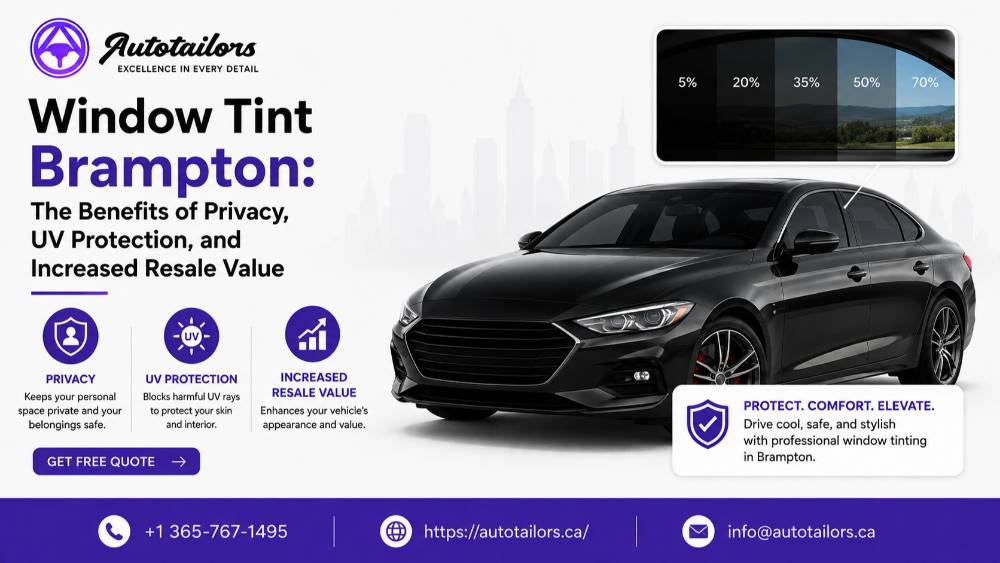
Important: Ontario law requires the front driver and passenger side windows to have a minimum 70% VLT, meaning the tint cannot block more than 30% of the light. Most cars already have factory glass with 75% to 80% VLT. Adding any aftermarket film to front windows will drop that number below 70% VLT—making it illegal.
According to Westside Pro , Ontario law does not explicitly authorize aftermarket tint percentages for front windows. Instead, it prohibits windows that “substantially obscure” the vehicle’s interior. Front side windows must allow at least 70% Visible Light Transmission (VLT). Windshield tint is prohibited for most vehicles manufactured after January 1, 2017.
What happens if you break the law?
- Police can stop you anytime. Dark front windows are easy to spot. Officers use handheld meters to check VLT at the roadside.
- You can be fined per illegal window.
- You will fail your safety inspection.
- Your insurance could be affected.
Bottom line for Brampton drivers: You cannot have dark front windows legally. Focus your dark tint on rear windows and choose a high-performance clear or light ceramic film for the front.
Extra Service: Paint Protection Film in Brampton
After your windows, protect your paint. Road salt, gravel, and car wash brushes destroy factory paint. Paint protection film Brampton from Autotailors is self-healing—small scratches vanish in the sun.
If you drive on the 410 or 407 every day, this is worth every dollar.
Why Choose Autotailors for Your Window Tint in Brampton
At Autotailors , we are Brampton’s trusted destination for premium window tinting and automotive styling.
What sets us apart:
- Premium materials: We use high-quality window films from trusted brands like 3M that reject up to 66% of total solar energy and up to 95% of infrared heat
- Certified installers: Our team applies film without bubbles or wrinkles
- Legal compliance: We only install tints that comply with Ontario’s Highway Traffic Act. We measure your factory glass and follow Ontario law exactly
- Lifetime warranty: If your tint ever bubbles, fades, or peels—we fix it
- Full-service solutions: From consultation to professional installation
- Serving the GTA: Brampton, Mississauga, Toronto, and surrounding areas
- Convenient location: 22 Strathearn Ave Unit 11B, Brampton, ON L6T 4S9
We also offer headlight and taillight tinting , car wraps , and partial wraps to complete your vehicle’s look.
Book Your Window Tint Today
Whether you choose dyed, carbon, or ceramic tint, the key is working with a professional shop that uses quality materials and ensures legal compliance. At Autotailors, we help Brampton drivers get the look they want while staying fully compliant with Ontario’s Highway Traffic Act.
Here is what you get when you book with us:
- A free consultation to understand your needs
- Expert advice on the best tint for your vehicle
- Professional installation by certified technicians
- A lifetime warranty on materials and workmanship
- Full compliance with Ontario tint laws
Contact us today for your free consultation.
Frequently Asked Questions (FAQs)
1. How much does window tinting cost in Brampton in 2026?
Window tinting in Brampton varies based on your vehicle type and film choice. Sedans cost less than SUVs, and ceramic tint is the premium option while dyed film is the most budget-friendly. Contact Autotailors for a custom quote.
2. What is the cheapest window tint option?
Dyed film is the most affordable option. It provides basic shading and privacy but offers limited heat rejection and may fade over time.
3. How much does ceramic window tint cost?
Ceramic tint is the premium option, offering the best heat rejection (up to 80–90%), 99% UV protection, and no signal interference. Contact Autotailors for accurate pricing.
4. Does window tinting increase insurance rates?
No. However, illegal tint can result in fines and safety inspection failures, which may affect your driving record and insurance.
5. How long does window tint installation take?
Typically 2 to 4 hours for a standard car, depending on vehicle size and the number of windows.
6. What is the legal window tint limit in Ontario?
Front side windows must allow at least 70% of light to pass through (70% VLT combined). Windshield tint is illegal except for a 3-inch top strip. Rear windows have no restrictions.
7. Can I tint my windshield in Ontario?
No. Windshield tint is illegal except for a small strip at the top (no more than 3 inches or 75 mm wide).
8. What is the difference between dyed, carbon, and ceramic tint?
Dyed tint is the most affordable but fades over time. Carbon tint offers better heat rejection and does not fade. Ceramic tint provides the highest heat rejection, UV protection, and durability with no signal interference.
9. Does window tinting protect against UV rays?
Yes. Ceramic and carbon films block up to 99% of harmful UV rays, protecting your skin and preventing interior fading and cracking.
10. Why should I choose Autotailors for my window tint?
Autotailors uses premium materials from industry leaders like 3M, certified installers, and ensures all installations comply with Ontario’s tint laws. We offer a lifetime warranty and serve Brampton, Mississauga, Toronto, and the entire GTA.
Final Thoughts
Window tinting is one of the smartest investments you can make for your vehicle. It reduces heat, blocks UV rays, enhances privacy, and protects your interior. But in Ontario, you must stay within the law.
The bottom line: Front side windows must allow more than 70% of light to pass through. Windshields cannot be tinted. Rear windows have no restrictions.
At Autotailors , we specialise in legal, high-quality window tinting. We use premium materials and ensure every installation complies with Ontario’s Highway Traffic Act.
Ready to upgrade your windows? Contact us today for a free consultation.